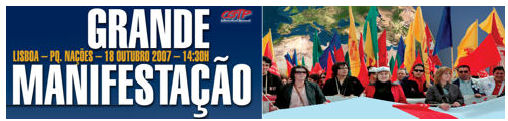
FOR A SOCIAL EUROPE – EMPLOYMENT WITH RIGHTS
RESOLUTION
The Portuguese workers, under the slogan FOR A SOCIAL EUROPE – EMPLOYMENT WITH RIGHTS, and with a strong sense of brotherhood, convey their solidarity to the European workers, in view of the common fight for better working conditions and a dignifying life, by claiming for social justice, progress and peace in the construction of Europe.
With the promise of economic growth and development of the country, more and more efforts go on being requested to the Portuguese workers.
As a result, most Portuguese workers see their real salaries decreasing, imbalances growing, poverty spreading, social and territorial cohesion weakened, equal opportunities disappearing and unemployment and precarious work boosting.
In other words, the country’s development has been put off.
Meanwhile, to solve the deficit in the public accounts and encourage the employer’s deals, the government cuts public expenditure, reduces the State functions and role, decreases public investment, attacks civil servant’s rights and imposes salary containment, while cutting the right to healthcare, education, social security, access to justice and other essential rights which are indispensable for the well being of the populations.
Moving on with its social agenda, the Government now intends to launch a disastrous revision of the Labour Code, simply to deregulate labour, liberalise labour relations and discard its commitments and those of the Socialist Party before the Portuguese workers. In so doing, the government will be perpetuating the production activity profile and model based on cheap, less qualified and precarious labour.
The Commission Report on the White Book of Labour Relations, instead of correcting the real problems of the current Labour Code, namely the drawbacks of collective bargaining and the inversion of the principle of a more favourable treatment, clearly encourages the employers to lay off workers more easily; to further increase precarious work; to decrease labour cost; to destroy collective bargaining; and to attack trade unions.
Therefore, one can be sure that the Report serves the main purpose of opening the door to an even more damaging revision of the Labour Code.
As a matter of fact, such Report is but a first step towards the introduction, in Portugal, of the so- called flexibility (more precariousness and less of rights), included in the flexicurity concept.
With regard to the concept of safety – to be translated into a fairer labour organisation, labour compensation and employment protection, which are grounds of both the Welfare State and cohesion of the most developed European societies – we have been witnessing to a succession of cuts in the rights of and in the protection of workers, namely in social security, health, education, qualification and access to justice.
Also with regard to active labour policies, considered to be the solution for labour problems, they are far from being sufficient and are but mere palliative measures if confronted with a continued lack of sustained economic growth.
This stresses the serious difficulties faced by the Portuguese workers, namely: a strong increase of unemployment, particularly affecting women, the youth and workers with more than 55 years; the growing precarious labour which grew from 465 in 1998 to more than 50% amongst the young population with less than 25 years; discrimination against female workers, who see the 17% salary difference with respect to male workers unchanged since 1998.
On the other hand, the education policies and the social policy options do not seem to respond to the country’s problems. The drop out rates, unsuccessful schooling and the increasing difficulties seen in higher education remain very serious.
The promised and announced convergence of Portugal with the European Union is but a further and further away mirage. What one is witnessing, indeed, is a constant diversion thereof due to the country’s unconditional submission to the observation of the criteria set forth in the Pact of Stability and Growth.
The very EU policies, however, have not favoured a positive evolution for the country. Despite the promises of full employment, modernisation of social protection schemes and the fight against poverty, considered as social framework measures to offset the imbalances resulting from the liberalisation of the economy, the Lisbon Strategy was mostly about the liberalisation of important activity sectors and not about compliance with the social commitments then approved. Quite on the contrary, unemployment rate remains high, precarious labour has increased, strong attacks against the workers’ rights, public services and social protection are constant.
With the current macro-economic policies and with the major political options which paved the way followed by the European Union, there will be no such Europe. The CGTP-IN highlights the need for confirmation of Social Europe and Employment with Rights.
The revision of the Treaty showed striking differences in the way several countries are conducting the European integration process. The mere subscription thereof is not enough to solve the problems EU is facing at the level of its internal and external relations.
CGTP-IN expresses its disagreement towards the Treaty in as much as it provides for the primacy of market values over all other values; does not recognise the political value of the Charter of The Fundamental Social Rights of Workers, when including it as an annex thereto; and allows some countries no to recognise the said Charter.
The citizens are clearly unhappy at the way Europe is being built. It is divorced from their essential interests and is a direct result of the European Commission, namely through the Public Service Directive, Organisation of Working Time Directive or the Green Book/Flexicurity. There being no referenda on the Treaty, the divorce will be even more visible.
A Social and Greater Solidarity Europe requires stronger Welfare States, ensuring effective social protection, public services with quality, labour markets regulated by labour rules pointing towards progress, collective bargaining and true and social dialogue, respecting the role and intervention of trade unions.
The European social model is an “acquis” of the European workers, which cannot and shall not be subject to any drawbacks or limitations restraining its essence.
Therefore, we hereby claim for a Social Europe and Employment with Full Rights and, as Portuguese workers, again we stress that in order to meet such a goal, the following is necessary, namely to:
- Promote collective bargaining and put an end to term contracts;
- Improve the purchasing power and to increase minimum wage to 426,5 euros;
- Stop unemployment and combat precarious labour;
- Review the damaging rules of the Labour Code, namely those concerning collective bargaining, the right to go on strike and precarious labour;
- Put an end to the offensive against Public Administration workers;
- Implement the effective right to continuous professional training;
- Invest in education;
- Ensure equal treatment at work and combat discrimination;
- Implement the workers rights; improve social protection and social security;
- Focus the health policy on the citizen;
- Promote justice and fiscal equality;
We further request that an end is put to attacks on trade unions and to the exercise of trade union activities, because with trade unions without fully exercising their rights and without claiming capacity, democracy would be mutilated.
The workers present at the great demonstration promoted by CGTP-IN under the slogan FOR A SOCIAL EUROPE – EMPLOYMENT WITH RIGHTS proclaim, namely:
- Their conviction to go on and increase trade union activity in the workplace, both at sector and region levels, around well grounded issues that reflect their real expectations.
Aware of the challenges faced by workers in general, it is imperative to:
- Clarify, mobilise and unite the workers with regard to their claims;
- Reinforce the solidarity bonds with young workers and workers of all ages, regardless of their professional status or labour bonds;
- Allow for convergence and conjugation of fights, so these become stronger and more efficient for the pursuance of its claims.
Lisbon, 18th October 2007